
The Armed Forces (Special Powers) Act, 1958, or AFSPA, as it is commonly known, has of late been a subject of intense discussion and debate. AFSPA has been in force in the North-East and Jammu and Kashmir, and the 'draconian' law has been the reason of wide protests.
A US-based human rights watchdog has urged the Indian government to repeal the Armed Forces Special Powers Act in force in Jammu and Kashmir and the north-east, alleging that it provides "impunity" for abuses and "fuels militancy".

The Central government has extended the Armed Forces (Special Powers) Act, 1958, for another six months in specified areas of Nagaland, Manipur, and Arunachal Pradesh, effective from October 1. This decision follows a review of the law and order situation in these northeastern states, maintaining the "disturbed area" declaration in various districts and police station jurisdictions.
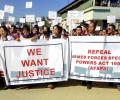
Several social organisations have also been opposing the AFSPA, which empowers security personal to shoot any suspect even causing death, and demanding its withdrawal from the state for many years.
The panel, comprising parliamentarians, politicians and representatives from Manipur, will 'review' the Act and replace it by a more 'humane' one.
The Cabinet is meeting today to discuss the situation arising out of the agitation to press for the withdrawal of the Act.
The Centre will look into the Armed Forces Special Powers Act (AFSPA) and consider "every essential aspect", Home Minister P Chidambaram said on Friday while making it clear that maintenance of law and order will be the primary responsibility of the Jammu and Kashmir government.

The Centre supported the pleas before a bench of Justices Madan B Lokur and U U Lalit against the lodging of FIRs against members of the armed forces in AFSPA-enforced areas.

'The Indian armed forces not only ensure protection of human rights of our own people but also of adversaries and deal with Prisoners of War as per the Geneva Conventions'
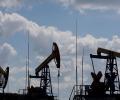
A tripartite pact -- amid the promise of removing AFSPA from almost all of the North East -- revives hydrocarbon exploration along the Assam-Nagaland border after decades of dormancy.
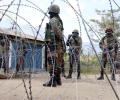
The Armed Forces (Special Powers) Act (AFSPA) has been extended for six months in parts of Manipur, Nagaland, and Arunachal Pradesh due to the prevailing law and order situation.

Two jawans of the Assam Rifles were killed and five others injured when a group of armed men ambushed a vehicle of the paramilitary force on September 19.

Modi's greater weakness is his inability since July when he directed the exit of Dharmendra Pradhan, to come up with a political counter strategy. Security measures and executive orders as seen in recent days will only likely further weaken him and make him as lame duck a premier as many prior to him, Indira Gandhi and Manmohan Singh included, observes Nilanjan Mukhopadhyay.

From intense gangster epics to tender slice-of-life dramas, these 10 films showcase why Dhanush remains one of Indian cinema's most versatile leading men.
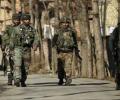
The AFSPA, often criticised as a draconian law, gives armed forces operating in disturbed areas sweeping powers to search, arrest and open fire if they deem it necessary.

Japan inaugurated the 20th Asian Games in Nagoya with a vibrant opening ceremony that seamlessly blended advanced technology and rich cultural traditions, despite earlier organisational challenges.
Amid clamour for withdrawal of Armed Forces (Special Powers) Act from Kashmir, a UN Special Rapporteur on Friday urged India to repeal the controversial law that gives its military special powers to act in troubled areas.

The IRGC is the most powerful branch of Iran's armed forces and operates independently of the country's regular military, answering directly to Supreme Leader Ali Khamenei.

We celebrate Mammootty's 75th birthday by revisiting blockbusters that shaped his superstar image without compromising his brilliance as an actor.

Sarma said his government will take further steps based on the suggestions of the home minister.

In her address to the nation on the eve of the country's 80th Independence Day, the president stressed that just as government and society remain united to ensure national security, everyone must contribute through joint and concerted efforts to safeguard the present and future of students.
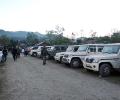
A fresh cycle of violence erupted in Manipur last Monday after 11 suspected militants, who allegedly attacked a police station and adjoining CRPF camp with sophisticated weapons in Manipur's Jiribam district, were killed in an exchange of fire.
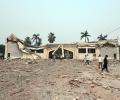
'We won not (only) because we were able to carry out long-range precision strikes.' 'That is, of course, one of the reasons but we had better situational awareness about what's happening than Pakistan.'
The Armed Forces (Special Powers) Act, 1958, or AFSPA, as it is commonly known, has of late been a subject of intense discussion and debate. AFSPA has been in force in the North-East and Jammu and Kashmir, and the 'draconian' law has been the reason of wide protests.
The extension comes three days after the Centre constituted a high-level committee under the chairmanship of Registrar General and Census Commissioner Vivek Joshi with Additional Secretary in the Union Home Ministry Piyush Goyal as its Member-Secretary.
The officials said that in the present environment where two communities are attacking each other, they may not find even a lawyer to defend them as all courts were within Imphal valley.

According to two separate notifications, the decisions have been taken after review of the law-and-order situation in both the states.

The Congress has promised to review and amend a host of laws, rules and regulations.

The 'key person' involved with the plan is still absconding, though the police have his whereabouts and he will be nabbed soon, Sarma said.
A caravan comprising about 20-22 people will cover 10 states to extend support to Irom Sharmila's protest against Armed Forces (Special Powers) Act, 1958. K Anurag reports.
Retired army personnel will be appointed as additional superintendents of police to impart training to the police force in Assam, Chief Minister Himanta Biswa Sarma said in Dergaon on Monday.
Pushing for partial withdrawal of controversial Armed Forces Special Powers Act, Jammu and Kashmir Chief Minister Omar Abdullah on Friday discounted suggestions that this will benefit terrorists, saying it is time to believe in the state police and paramilitary forces
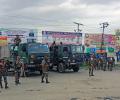
Tirap, Changlang and Longding districts of Arunachal Pradesh and eight police stations bordering Assam were declared "disturbed" areas under the Armed Forces (Special Powers) Act (AFSPA), 1958.
The proposal to remove the Armed Forces Special Powers Act in some parts Kashmir is a ploy by anti-India forces to show that they are still relevant, says Tarun Vijay.
Armed Forces (special Powers) Act should not be revoked until the proxy war in Jammu and Kashmir is stopped and the state police machinery is able to handle the normal law and order situation. R S Chauhan reports.
Amidst controversy over the issue of revocation of Armed Forces Special Powers Act from parts of Jammu and Kashmir, Defence Minister A K Antony on Friday said that the final decision on it would be taken by the Unified Command Headquarters in the state.
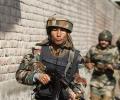
The AFSPA will continue to remain in force in 12 districts of Arunachal Pradesh for six more months.
The shrill politically-driven rhetoric demanding that the Armed Forces Special Powers Act be repealed, if allowed to hold sway, may drive us deeper into the dark world of both Islamist terror and the Maoist insurgency, warns Brigadier S K Chatterji (retd).
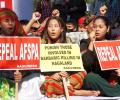
Manipur has been experiencing unrest on account of the people's unhappiness with the alleged misuse of the Armed Forces (Special Powers) Act. They are demanding that it be repealed.
